


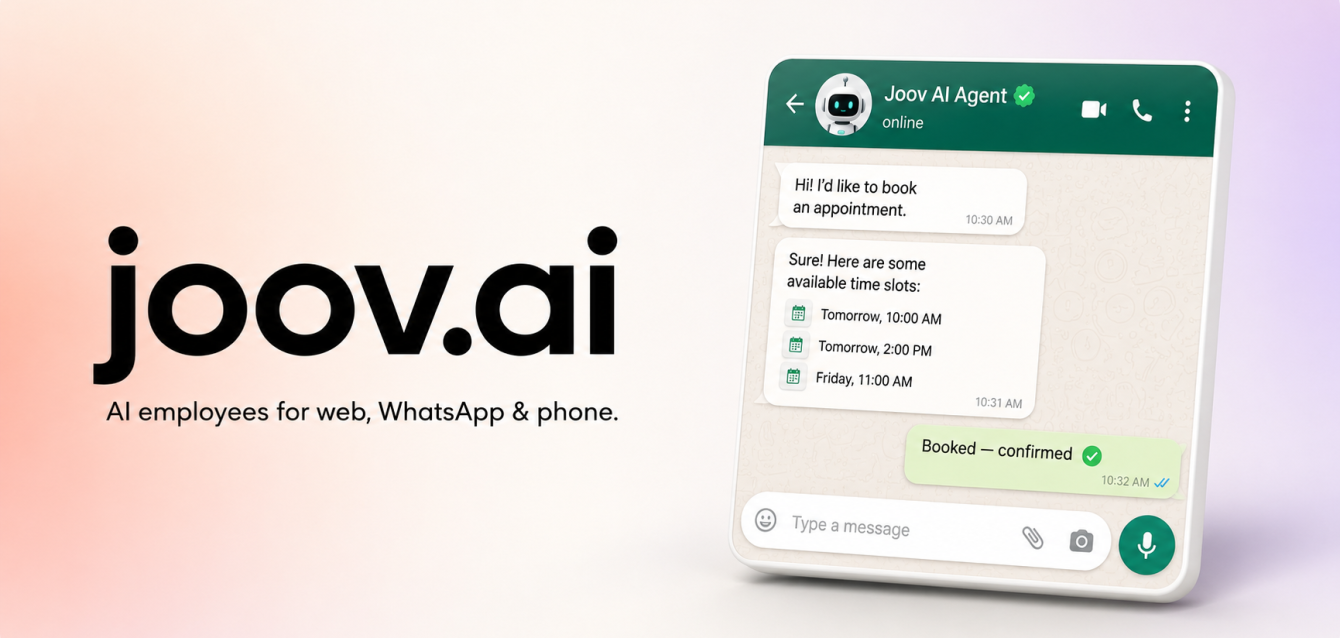
For many small businesses, the front desk is where revenue is either captured or lost. A missed phone call can become a missed appointment. A slow WhatsApp reply can become a lost lead. A customer who only wanted opening hours, pricing, or availability may move to a competitor if the business does not answer quickly.
For years, the traditional solution was simple: hire a receptionist, use an answering service, or send calls to voicemail. Today there is another option: an AI receptionist that can answer phone calls, respond on WhatsApp, handle website chat, qualify leads, book appointments, and escalate complex cases to a human.
So which is better for a small business: an AI receptionist or a human answering service? The honest answer is not that AI always wins, or that humans are always better. The better question is: which conversations should be automated, and which conversations should be handled by a human?
Research on conversational agents and hybrid customer-service systems points to a practical conclusion. AI is strongest when the task is structured, repeatable, time-sensitive, and data-driven. Humans remain important when the conversation is emotional, sensitive, unusual, or requires judgment. For many small businesses the best model is therefore not AI-only or human-only: it is AI-first, with a human handoff when needed.
The short answer
An AI receptionist is usually better for
- Answering instantly, 24/7
- Handling repetitive questions
- Booking appointments
- Collecting lead details and qualifying requests
- WhatsApp and website chat
- Answering several customers at the same time
- Summarizing every conversation for the owner
A human answering service is usually better for
- Emotionally sensitive conversations
- Unusual complaints
- Complex judgment calls
- Legal, medical, or financial nuance
- When the customer clearly wants a person
- Negotiation and relationship-heavy calls
The strongest setup is usually this: the AI answers first, handles the simple tasks, collects context, and escalates the complex cases to a human.
What is an answering service?
An answering service is a human-operated service that answers calls on behalf of a business. Depending on the provider, it may take messages, transfer calls, answer basic questions, schedule appointments, cover after-hours calls, route emergencies, and support several businesses from a single call center.
For small businesses these services are useful because they provide a human presence without hiring a full-time receptionist. But they also have limits. Operators may not know the business deeply, may follow rigid scripts, can make mistakes when passing information along, and tend to get more expensive as call volume grows.
What is an AI receptionist?
An AI receptionist is a conversational system that acts as the first point of contact for customers, working through phone calls, website chat, WhatsApp, SMS, or other channels. A good one can answer common questions, understand intent, collect a caller’s name, phone, service type, location and urgency, book or reschedule appointments, send summaries to the business, transfer urgent cases to a person, work outside business hours, and keep its answers consistent with the business knowledge base.
The key point: a useful AI receptionist is not just a chatbot that asks how it can help. It has to be connected to real workflows: calendar, service rules, opening hours, escalation logic, CRM, WhatsApp, phone routing, and internal notifications.
AI receptionist vs answering service at a glance
| Feature | AI Receptionist | Human Answering Service |
|---|---|---|
| 24/7 availability | Strong | Depends on plan |
| Instant response | Strong | Good, but may queue |
| Multiple simultaneous calls or chats | Strong | Limited by staff |
| Repetitive questions | Strong | Good, but inefficient |
| Appointment booking | Strong if integrated | Good if trained |
| WhatsApp and web chat | Strong | Depends on provider |
| Human empathy | Improving, but limited | Strong |
| Complex judgment | Limited | Stronger |
| Sensitive complaints | Escalate to a human | Stronger |
| Consistency | Strong | Varies by operator |
| Cost scaling | Usually efficient | Can rise with volume |
| Business-specific knowledge | Strong if trained well | Depends on scripts |
| Reporting and summaries | Strong | Depends on provider |
| Best role | First response and automation | Human judgment and escalation |
Where AI receptionists are stronger
Speed
Customers do not like waiting. Someone calling a clinic, a garage, a real estate agency or a home-service business usually wants a fast answer: are you open, can I book, how much does it cost, do you serve my area, can someone call me back. An AI receptionist answers immediately, at night, during lunch, or while the team is busy. For many businesses, speed alone pays for the system: every lead it catches before it rolls to voicemail is a lead saved.
Repetitive questions
Most businesses get the same questions over and over: opening hours, location, services, pricing, whether they take new customers, how to book, whether photos can be sent over WhatsApp, what to bring, whether there is an emergency service. A human can answer all of these, but it is not the best use of their time. AI is well suited to repeatable, structured information.
Booking and lead capture
A traditional answering service usually takes a message. An AI receptionist can go further and collect structured details: name, phone, email, requested service, preferred time, urgency, city, budget or property type, and the reason for the visit, then book it straight into the calendar or send the owner a clean summary. For a clinic that means booked consultations; for a home-service business, a qualified job request; for a real estate agency, the property type, budget, location and availability. This is where AI stops being “answering the phone” and becomes a front-office workflow.
Multiple customers at once
A human receptionist handles one conversation at a time. A call center handles more, but only with enough operators on shift. An AI receptionist handles many chats or calls in parallel, which matters most at the peaks: Monday morning, lunchtime, the hours after an ad campaign, after-hours emergencies, and seasonal demand.
Consistency
Human operators vary. One explains a service clearly; another forgets a detail. One collects the right information; another leaves the owner an incomplete message. An AI receptionist follows the same logic every time: ask the required questions, check the right rules, give the approved answer, escalate when needed, and summarize the conversation in a standard format. That is especially valuable when the business has clear workflows.
Where human answering services are stronger
Emotional conversations
People are still better when the customer is upset, confused, angry, scared, or in a sensitive situation. Studies of customer-service AI keep finding the same pattern: AI can be efficient and consistent, but trust, empathy and emotional fit remain hard. In sensitive cases a human handoff is not a failure; it is good design.
Complex judgment
Some conversations do not fit a script: a customer wants an exception, a patient describes unusual symptoms, a tenant has a legal dispute, a client is angry about previous service, someone asks for advice that could create liability, or a high-value lead wants a custom proposal. In these cases the AI should collect context and route the case to a person.
Relationship-heavy businesses
Some businesses run on personal trust: private medical practices, legal services, luxury and financial services, high-end real estate. AI still helps them, but it should act as a first-response layer rather than the only point of contact.
The best model: AI-first with human handoff
The most practical model is not “replace the receptionist.” It is: let AI handle the front layer, and let people handle the exceptions. A good AI receptionist knows when to stop and escalate.
- A customer calls after hours.
- The AI answers immediately.
- It identifies the reason for the call.
- If it is simple, it answers or books an appointment.
- If it is urgent, sensitive, or complex, it sends a summary to a human or transfers the call.
- The owner gets real context instead of a vague voicemail.
This hybrid design is exactly how research on customer-service systems treats the combination of virtual agents and human operators: handoff is a central design problem, not an afterthought. The insight for a small business is simple: the AI does not need to pretend to be perfect. It needs to be reliable, useful, and clear about when a human is needed.
Examples by business type
Clinics and private practices
AI handles
- Opening hours and directions
- Treatment information
- Booking, reminders and intake
- WhatsApp follow-up and call summaries
Escalate to a human
- Medical emergencies and unusual symptoms
- Distressed patients and complaints
- Anything diagnosis-related
Dental and aesthetic clinics
AI handles
- Price ranges and treatment categories
- Consultation availability and booking
- Before and after instructions
- Location, parking and payment questions
Escalate to a human
- Complications and urgent pain
- Detailed clinical advice
- High-value treatment planning
Home-service businesses
AI handles
- Location, problem type and urgency
- Photos over WhatsApp and access notes
- Preferred time and contact details
- A structured job summary for the technician
Escalate to a human
- True emergencies
- Quotes that need judgment
Garages and auto repair
AI handles
- Car make, model and the problem
- Warning lights and whether it still drives
- Photos or video and preferred time
- Common questions and booking
Escalate to a human
- Diagnosis
- Quote approval
Real estate agencies
AI handles
- Buyer or seller, budget and area
- Property type and timeline
- Financing status and viewing times
- Listing questions and call scheduling
Escalate to a human
- Negotiation
- High-value or sensitive clients
Cost comparison
The cost gap depends on the provider, call volume, integrations and complexity. A human answering service usually charges by minutes, call volume or plan level: affordable at low volume, but more expensive as the business grows. An AI receptionist usually has a setup cost and a monthly fee that depends on channels, usage, phone minutes, WhatsApp messages, integrations and customization.
The right way to compare is not the monthly price alone. Compare the outcomes:
- How many missed calls are captured?
- How many appointments are booked?
- How much staff time is saved?
- How many leads are answered after hours?
- How many customers get a faster reply?
- How many conversations are summarized automatically?
A cheaper option that only takes messages can be worth far less than a system that actually books appointments and captures leads.
Questions to ask before choosing
- Can it answer 24/7?
- Can it book appointments directly?
- Does it support phone, WhatsApp and website chat?
- Can it transfer to, or notify, a human?
- Can it handle several conversations at once?
- Can it summarize every conversation?
- Can it collect structured lead information?
- Can the business control the answers?
- What happens when it does not know the answer?
- Are call recording, privacy and data handling clear?
- Does it support your customers’ languages?
- Can it integrate with your calendar, CRM or workflow?
Frequently asked questions
Can an AI receptionist replace an answering service?
Sometimes, but not always. It can replace many repetitive answering-service tasks (FAQs, booking, lead capture and after-hours response), while sensitive, emotional or complex conversations are escalated to a human.
Is an AI receptionist cheaper than a human answering service?
Often, especially as call volume grows or when you need 24/7 coverage. But the real comparison should include missed leads recovered, booking value, staff time saved and response speed.
Can an AI receptionist answer phone calls?
Yes. A modern AI receptionist answers calls using speech recognition, text generation and text-to-speech, and can also work over WhatsApp, SMS and website chat depending on the setup.
Can an AI receptionist book appointments?
Yes, when it is connected to your calendar or booking system. Without integration it can still collect appointment requests and send them to staff.
What happens if the AI does not know the answer?
A well-designed AI receptionist should not guess. It asks a clarifying question, uses the approved knowledge base, or escalates to a human with a summary of the conversation.
Is AI suitable for clinics?
Yes, for administrative work: booking, reminders, FAQs, directions and intake. It should not provide a diagnosis or replace medical judgment.
What is the best setup for a small business?
For most small businesses, AI-first with human handoff. The AI answers immediately and handles routine work, while people handle the sensitive or complex cases.
Conclusion
The debate should not be “AI receptionist or human answering service.” The real question is how to design the front desk so customers are answered quickly, routine work is automated, and human attention is saved for the conversations where it truly matters.
An AI receptionist is usually better for speed, availability, consistency, booking, lead capture and structured workflows. A human answering service is usually better for empathy, judgment, complaints and sensitive conversations. For many small businesses, the winning model is simple: AI first, a human when needed, every customer answered, every lead captured.
See it answer for your business
Joov builds done-for-you AI receptionists for WhatsApp, voice calls and website chat, trained on your business, deployed end-to-end in days.
Sources
Kraus et al., “Customer Service Combining Human Operators and Virtual Agents,” AAAI Conference on Artificial Intelligence · Barbosa and Godoy, “Augmenting Customer Support with an NLP-based Receptionist” · Radziwill and Benton, “Evaluating Quality of Chatbots and Intelligent Conversational Agents” · Wang, “Building User Trust in AI Chatbots for Customer Service,” Scientific Reports · Howcroft et al., “AI Chatbots Versus Human Healthcare Professionals: Empathy in Patient Care.”
Get AI automation tips
Occasional, useful emails on capturing more leads and answering customers faster. No spam.